How-to
Scope 1, 2 and 3 emissions explained, with a worked bakery example
The GHG Protocol sorts a company’s emissions into three scopes: what it burns, the energy it buys, and everything else in its value chain. Here is what goes where, using one small bakery as the example.
What are scope 1, 2 and 3 emissions?
Scope 1 is what a company emits itself, scope 2 is the emissions from the energy it buys, and scope 3 is everything else caused by its value chain, from the farms and factories that supply it to the customers who use and throw away what it sells. The three scopes come from the Greenhouse Gas Protocol, the accounting standard behind almost all corporate climate reporting.
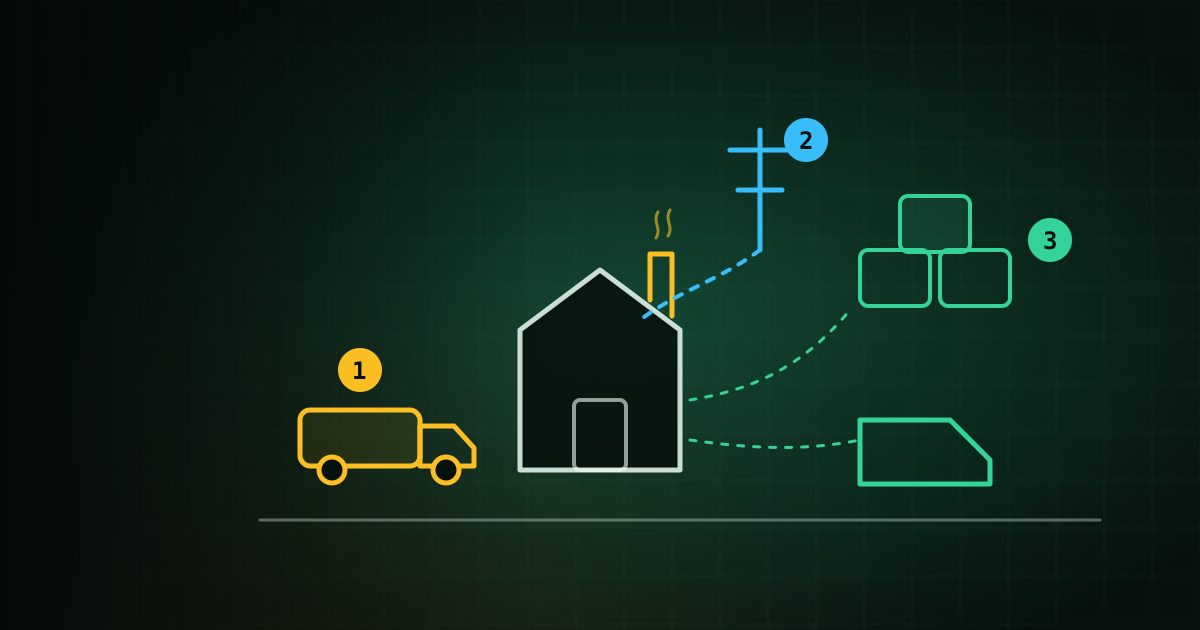
Take a small bakery with two shops, gas ovens and a delivery van. The gas burned in the ovens and the diesel in the van are scope 1. The electricity for mixers, fridges and lights is scope 2, because it is generated at a power station somewhere else. The flour, butter, sugar and packaging it buys, and the bread customers throw away, are scope 3.
This guide goes deeper into the scopes themselves. For the step-by-step process of collecting data and choosing emission factors, see our broader guide on how to track carbon emissions.
Why the GHG Protocol uses scopes
The GHG Protocol is a partnership convened by the World Resources Institute (WRI) and the World Business Council for Sustainable Development (WBCSD). It launched in 1998, published its Corporate Standard in 2001 and a revised edition in 2004, and added the Scope 3 Standard in 2011. According to the GHG Protocol, 97% of S&P 500 companies that disclosed to CDP in 2023 used its methods.
Scopes answer two practical questions: who controls this emission, and could it be counted twice inside one report. Splitting direct from indirect emissions shows what a company can cut with its own equipment, what depends on its energy choices, and what depends on suppliers and customers.
Before assigning scopes, a company sets its boundary: which subsidiaries, sites and joint ventures count. The Corporate Standard allows three approaches (equity share, financial control or operational control), and the choice can move an asset between scopes. Inventories cover seven gases: carbon dioxide, methane, nitrous oxide, HFCs, PFCs, sulphur hexafluoride and nitrogen trifluoride, all converted to CO₂-equivalent (CO₂e).
Scope 1: direct emissions
Scope 1 covers greenhouse gases released from sources the company owns or controls. They fall into four groups:
- Stationary combustion: gas ovens and boilers in the bakery; a gas-fired furnace or kiln in a factory; a backup diesel generator in an office.
- Mobile combustion: the bakery’s delivery van, a manufacturer’s forklifts and lorries, company cars.
- Process emissions: gases released by chemical reactions rather than burning fuel, such as CO₂ from limestone in cement making.
- Fugitive emissions: leaks, above all refrigerant escaping from the bakery’s fridges or an office’s air-conditioning. Many refrigerants are potent HFCs, so small leaks matter.
The data usually sits in records the company already has: gas bills, fuel cards and refrigerant service logs.
Scope 2: purchased electricity, heat, steam and cooling
Scope 2 covers the emissions from generating the electricity, steam, heat and cooling a company buys and uses. The gas is released at the power station or district heating plant, not at the bakery, which is why it is indirect. For many offices, scope 2 is the larger of the two operational scopes.
Since the GHG Protocol’s 2015 Scope 2 Guidance, companies operating in markets with energy contracts or certificates report scope 2 in two ways, side by side:
| Method | What it uses | What it shows |
|---|---|---|
| Location-based | The average emission factor of the grid where the electricity is used | The emissions physically associated with the grid you draw from |
| Market-based | The company’s contracts: supplier-specific rates, power purchase agreements and energy attribute certificates (such as RECs or Guarantees of Origin), with a residual-mix factor for anything uncovered | The effect of the company’s purchasing choices |
A worked example with illustrative numbers: the bakery uses 50,000 kWh a year on a grid averaging 0.25 kg CO₂e per kWh. Its location-based scope 2 is 50,000 × 0.25 = 12,500 kg, or 12.5 tonnes. If it switches to a tariff backed by certificates that meet the Guidance’s quality criteria, its market-based figure can fall close to zero, while the location-based figure stays at 12.5 tonnes because the grid has not changed.
Upstream emissions from producing the fuels that power stations burn, and electricity lost in the wires before it reaches you, do not go in scope 2. They belong in scope 3, category 3.
Scope 3: the 15 categories, upstream and downstream
Scope 3 covers all other indirect emissions in the value chain. The Scope 3 Standard groups them into 15 categories: eight upstream, linked to what the company buys, and seven downstream, linked to what it sells. Companies report the relevant categories and explain any they leave out.
| # | Category | Example |
|---|---|---|
| Upstream | ||
| 1 | Purchased goods and services | Growing and milling the bakery’s flour, making its butter and bags; an office’s IT services |
| 2 | Capital goods | Manufacturing a new deck oven, delivery van or shop fit-out |
| 3 | Fuel- and energy-related activities (not in scope 1 or 2) | Extracting and transporting the gas the ovens burn; grid transmission losses |
| 4 | Upstream transportation and distribution | A haulier delivering flour that the bakery pays for |
| 5 | Waste generated in operations | Unsold bread and packaging sent to landfill or composting |
| 6 | Business travel | The owner’s flight and hotel for a trade fair |
| 7 | Employee commuting | Staff driving to the 5 a.m. shift; office workers’ home working, which companies may include |
| 8 | Upstream leased assets | A rented storage unit, if its energy is not already in scope 1 or 2 |
| Downstream | ||
| 9 | Downstream transportation and distribution | A café chain collecting the bakery’s bread in its own vans |
| 10 | Processing of sold products | A supermarket baking off the bakery’s part-baked loaves; a car maker machining a manufacturer’s steel parts |
| 11 | Use of sold products | Small for bread; large for an oven maker (the electricity its ovens use) or a car maker (fuel burned in its cars) |
| 12 | End-of-life treatment of sold products | Disposal of the boxes and bags the bakery’s products leave with |
| 13 | Downstream leased assets | A kiosk the bakery owns and rents to another operator |
| 14 | Franchises | Franchised shops trading under the bakery’s name |
| 15 | Investments | The bakery’s stake in a flour mill; for a bank, the emissions of the companies it lends to |
Which categories dominate depends on the business. For the bakery it is almost certainly category 1, because farming wheat and dairy is emissions-intensive. For a car or appliance maker it is usually category 11; for a bank, category 15.
Why scope 3 is usually the largest share, and the hardest to measure
Scope 3 is large because it contains other companies’ scope 1 and 2. Every supplier’s furnace and every customer’s car sits somewhere in it. In a 2024 analysis of data disclosed to CDP, the supply-chain (upstream scope 3) emissions companies disclosed in 2023 averaged 26 times their operational scope 1 and 2 emissions. The same report found companies were twice as likely to measure operational emissions as supply-chain ones, and only 15% of disclosing companies had set a target for upstream scope 3.
It is hard to measure because the data belongs to someone else. The GHG Protocol’s calculation guidance describes a ladder of methods; the main ones are:
- Spend-based: money spent per category × an average emission factor per euro or dollar. Quick, but a pricier bag of flour looks more polluting even if it isn’t.
- Average-data: physical quantities, such as tonnes of flour, × an industry-average factor.
- Supplier-specific: the supplier’s own measured emissions for the product. Most accurate, and the only method that shows the effect of choosing a lower-carbon supplier.
Most companies start with spend-based screening across all 15 categories, then move their largest categories up the ladder.
Double counting between companies is expected
The bakery’s purchased flour (its category 1) is the mill’s scope 1 and 2 plus the farm’s emissions. The bakery’s electricity (its scope 2) is the power station’s scope 1. The same tonne of CO₂ therefore appears in several inventories, and the GHG Protocol accepts this by design: it gives each company in the chain a reason to act, from the farmer to the retailer.
What must be avoided is double counting within one inventory, such as counting the bakery’s own van in scope 1 and again in category 4, and adding different companies’ inventories together to get a total. National totals, like those in our CO₂ emissions by country ranking, are built differently: each country counts emissions released on its territory once, which is how the live global counter can add them up.
How scopes relate to your personal carbon footprint
Scopes are a company tool, but the logic carries over to a household:
- Like scope 1: petrol or diesel in your car, gas or oil in your boiler.
- Like scope 2: the electricity you buy, and district heating if you have it.
- Like scope 3: food, clothes, electronics, flights and services, all made or delivered by someone else.
The overlap runs both ways: the petrol you burn is also category 11 for the car maker and the oil company. You can estimate all three parts of your own footprint with our carbon footprint calculator.
Common misconceptions about scopes
- “Scope 1 is just CO₂ from burning fuel.” It covers all seven gases, including refrigerant leaks and process emissions.
- “Renewable certificates make our electricity zero-carbon.” They can lower the market-based figure. The location-based figure still reflects the grid, and both must be reported.
- “Grid losses and upstream fuel emissions are scope 2.” They are scope 3, category 3.
- “Scope 3 is optional, so it doesn’t matter.” It is optional under the Corporate Standard, but for most companies it is where most emissions are, and disclosure rules such as IFRS S2 ask for it.
- “Scope 3 is someone else’s problem.” A company cannot cut it alone, but it decides what it buys, how products are designed and which suppliers it uses.
- “Scope 4 is the emissions a product helps avoid.” There is no scope 4 in the GHG Protocol. Avoided emissions are reported separately, never subtracted from scopes 1 to 3.
Are the scope rules changing?
Yes, gradually. The GHG Protocol is revising its Corporate Standard, Scope 2 Guidance and Scope 3 Standard, overseen by an Independent Standards Board. A public consultation on Scope 2 ran from 20 October 2025 to 31 January 2026; its proposals keep dual reporting but would require market-based contracts to be matched to consumption hour by hour and to come from generation that can be delivered to the consuming grid, with relief for smaller companies and a phased start.
None of this is final: the first consultation has closed, a further round is expected, and new standards are not expected before 2027. Until revised standards are published, the 2004 Corporate Standard, 2015 Scope 2 Guidance and 2011 Scope 3 Standard apply, and this guide follows them.
Questions and answers
What is the difference between scope 1 and scope 2 emissions?
Scope 1 emissions come out of sources the company owns or controls, such as its boilers, ovens and vehicles. Scope 2 emissions happen at the power station or heat plant that produces the electricity, steam, heat or cooling the company buys. The test is where the gas is released: on your site or in your vehicles is scope 1, at someone else’s plant making energy for you is scope 2.
What are scope 3 emissions?
Scope 3 emissions are all the indirect emissions in a company’s value chain that are not in scope 2: making the goods it buys, transporting them, business travel, staff commuting, waste, and the use and disposal of the products it sells. The GHG Protocol groups them into 15 categories.
What are the 15 scope 3 categories?
Upstream: 1 purchased goods and services, 2 capital goods, 3 fuel- and energy-related activities, 4 upstream transportation and distribution, 5 waste generated in operations, 6 business travel, 7 employee commuting, 8 upstream leased assets. Downstream: 9 downstream transportation and distribution, 10 processing of sold products, 11 use of sold products, 12 end-of-life treatment of sold products, 13 downstream leased assets, 14 franchises, 15 investments.
Is scope 3 reporting mandatory?
Under the GHG Protocol Corporate Standard, scope 3 is optional, while scopes 1 and 2 are required. Whether a company must report it depends on the rules it falls under: the ISSB’s IFRS S2 climate standard, for example, asks for scope 3 disclosure, and many customers and target-setting schemes expect it too.
Are my personal emissions scope 1, 2 or 3?
Scopes are a company accounting tool, but the idea maps neatly onto a household: the fuel you burn in your car and boiler is like scope 1, your electricity is like scope 2, and the food, goods and flights you buy are like scope 3. A carbon footprint calculator covers all three.
Sources
- GHG Protocol Corporate Accounting and Reporting Standard (Revised Edition), World Resources Institute and WBCSD, 2004
- GHG Protocol Scope 2 Guidance, World Resources Institute and WBCSD, 2015
- GHG Protocol Corporate Value Chain (Scope 3) Standard, World Resources Institute and WBCSD, 2011
- Technical Guidance for Calculating Scope 3 Emissions, GHG Protocol, 2013
- About us: what is GHG Protocol? (97% of disclosing S&P 500 companies in 2023), GHG Protocol
- Greenhouse Gas Protocol: history and standards, World Resources Institute
- GHG Protocol public consultations: Scope 2 and electricity sector consequential accounting, GHG Protocol, 2025
- Scope 3 Upstream: Big Challenges, Simple Remedies, CDP and Boston Consulting Group, 2024
- Corporates’ supply chain scope 3 emissions are 26 times higher than their operational emissions, CDP press release, 2024
- Scopes 1, 2 and 3 Emissions Inventorying and Guidance, US Environmental Protection Agency
- Scope 3 Inventory Guidance, US Environmental Protection Agency
- IFRS S2 Climate-related Disclosures, International Sustainability Standards Board, 2023