Climate science
Remaining carbon budget for 1.5 °C: how much is left in 2026, and what it means
A carbon budget is the CO₂ the world can still emit before a warming limit is likely to be passed. For 1.5 °C it is nearly used up. Here is how big it is, why estimates differ, and what “running out” really means.
How much carbon budget is left for 1.5 °C?
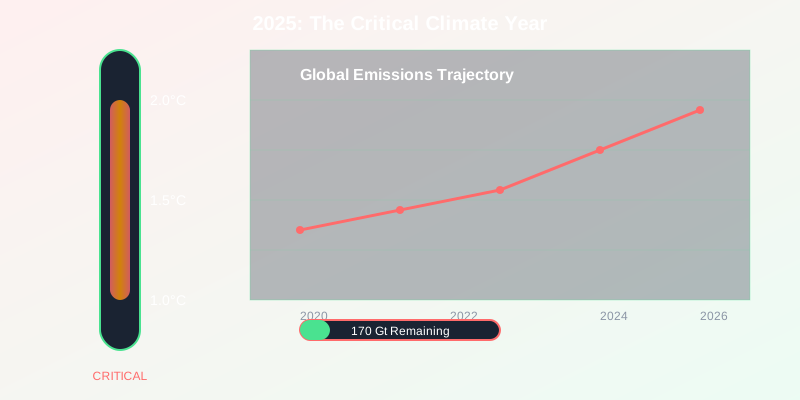
From 1 January 2026, the world could emit about 170 billion tonnes (Gt) of CO₂ and still have a 50% chance of limiting warming to 1.5 °C, according to the Global Carbon Budget 2025. At the 2025 rate of 42.2 Gt a year, that is about four years. A second major assessment, the Indicators of Global Climate Change 2025, puts the figure lower, at 130 Gt CO₂, or a little over three years.
Either way, the budget runs out around 2029–2030 if emissions stay where they are. You can watch it shrink in real time on our live CO₂ counter, which subtracts about 1,338 tonnes from the 170 Gt figure every second.
By late October 2026, if this year’s emissions are similar to last year’s, about 34 Gt of the 170 Gt will already have been used, leaving roughly 136 Gt on the Global Carbon Budget basis, or under 100 Gt on the lower estimate.
What is a carbon budget?
A carbon budget is the total amount of CO₂ that can still be emitted while keeping global warming below a chosen limit, such as 1.5 °C or 2 °C above the 1850–1900 average, with a stated probability.
The idea works because of a simple physical relationship. CO₂ stays in the atmosphere for centuries, so warming depends on the cumulative total emitted, not on the emissions of any one year. The IPCC’s Sixth Assessment Report (AR6) found that warming rises almost in a straight line with cumulative CO₂. This ratio is called the transient climate response to cumulative emissions (TCRE).
Between 1850 and 2019, humans emitted about 2,390 Gt of CO₂ (IPCC AR6). The remaining budget is what is left once that history, recent emissions and the extra warming from other gases are accounted for. It behaves like a fixed allowance: every tonne emitted this year is a tonne that cannot be emitted later.
How much is left for 1.5 °C, 1.7 °C and 2 °C?
The table shows the latest central estimates, all for a 50% chance and counted from the start of 2026. “Years left” divides each budget by the 2025 total of 42.2 Gt CO₂.
| Warming limit | Source | Remaining budget (Gt CO₂) | Years at 2025 emissions |
|---|---|---|---|
| 1.5 °C | Indicators of Global Climate Change 2025 | 130 | about 3 |
| 1.5 °C | Global Carbon Budget 2025 | 170 | about 4 |
| 1.7 °C | Global Carbon Budget 2025 | 525 | about 12 |
| 2 °C | Global Carbon Budget 2025 | 1,055 | about 25 |
Notice that each step up in temperature buys much more room. In the Global Carbon Budget figures, the gap between 1.5 °C and 2 °C is about 885 Gt, more than 20 years of current emissions. That is why scientists stress that 1.7 °C is very different from 2 °C, even once 1.5 °C is out of reach.
What about a 67% or 83% chance?
A 50% budget is a coin toss. For better odds, the budget is smaller. The IPCC’s AR6 report gives the clearest comparison, although its figures start from 2020 and are now out of date:
| Warming limit | 50% chance | 67% chance | 83% chance |
|---|---|---|---|
| 1.5 °C | 500 | 400 | 300 |
| 2 °C | 1,350 | 1,150 | 900 |
Since 2020 the world has emitted roughly 39–42 Gt of CO₂ a year. Six years of that is about 250 Gt, which on AR6’s own numbers leaves little or nothing of the 83% budget for 1.5 °C. Put the two together: of the 370 Gt gap between AR6’s 500 Gt (counted from 2020) and the Indicators team’s 130 Gt (from 2026), about 250 Gt is simply what the world emitted in between; the rest reflects updated estimates of how much warming has already happened.
Why do carbon budget estimates differ and keep shrinking?
The most obvious reason is that emissions continue. In 2025 the world emitted 42.2 Gt of CO₂: 38.1 Gt from fossil fuels and cement, a record and 1.1% more than in 2024, plus 4.1 Gt from land-use change. Every one of those tonnes came straight off the budget.
But budgets also shrink faster than emissions alone would explain. The Global Carbon Budget’s previous edition gave about 235 Gt from the start of 2025; a year later it was 170 Gt, a fall of about 65 Gt in a year when 42 Gt was emitted. Three things explain the extra changes and the gap between the 130 Gt and 170 Gt estimates:
- How much warming has already happened. Human-caused warming reached about 1.37 °C in 2025 and is rising at about 0.27 °C per decade, the fastest rate on record. A slightly higher estimate of past warming leaves less room, and at this scale a few hundredths of a degree is worth tens of billions of tonnes.
- Non-CO₂ warming. Methane, nitrous oxide and the loss of cooling from air pollution as fossil fuel use falls all add warming that CO₂ must make room for. The IPCC notes these assumptions alone can move a budget by 220 Gt or more.
- Methods and data. The two teams combine models differently and use updated historical emissions, so their central estimates differ even though each lies well inside the other’s uncertainty range.
This is also why a CO₂-only calculation gives a misleadingly large answer. With 0.13 °C left to 1.5 °C, TCRE alone would suggest nearly 300 Gt of room. The published budgets are well below that because part of the remaining warming is taken up by non-CO₂ factors.
What does “running out” of the carbon budget actually mean?
Running out of the 1.5 °C budget is not a cliff edge. Nothing physical changes on the day the counter reaches zero. It means that the CO₂ already emitted makes it more likely than not that warming will exceed 1.5 °C, unless CO₂ is later removed from the atmosphere.
It also does not mean the 1.5 °C goal of the Paris Agreement has been formally breached. That goal refers to long-term warming, measured over about 20 years, not to a single hot year. Human-caused warming was 1.37 °C in 2025; at 0.27 °C per decade, it would reach 1.5 °C around 2030.
Most importantly, the budget does not stop mattering once it is used up. Warming keeps tracking cumulative CO₂, so every additional 220 Gt or so adds roughly another 0.1 °C. The difference between peaking at 1.6 °C and at 1.9 °C is very large for heatwaves, sea-level rise and ecosystems.
What is overshoot, and can we come back below 1.5 °C?
Overshoot means temporarily exceeding a warming limit and later bringing temperatures back down. Because warming follows cumulative CO₂, the only way to lower it is to make cumulative emissions fall: the world would have to reach net-negative emissions, removing more CO₂ each year than it emits. The IPCC finds that sustained net-negative CO₂ emissions would gradually reverse CO₂-driven warming, but other changes, such as sea-level rise, would continue for centuries.
The scale is daunting. Using TCRE, cooling the planet by 0.1 °C would take about 220 Gt of net CO₂ removal. Today, carbon dioxide removal totals about 2 Gt a year, almost all from forests; novel methods such as direct air capture and biochar removed only around 1.3 million tonnes a year, according to the 2024 State of Carbon Dioxide Removal report. Overshoot is therefore a backstop, not a plan: the lower the peak, the less removal is needed.
What does the carbon budget mean for emissions cuts?
A helpful way to read a budget is to imagine emissions falling in a straight line to zero. The total emitted along the way is half of today’s rate times the number of years, so the budget sets how fast the line must drop. This is a simplified illustration, not a forecast:
| Budget | Years to net zero | Net zero around | Cut needed each year |
|---|---|---|---|
| 130 Gt (1.5 °C, Indicators of Global Climate Change) | 6 | 2032 | 6.8 Gt (16% of 2025 level) |
| 170 Gt (1.5 °C, Global Carbon Budget) | 8 | 2034 | 5.2 Gt (12%) |
| 525 Gt (1.7 °C) | 25 | 2051 | 1.7 Gt (4%) |
| 1,055 Gt (2 °C) | 50 | 2076 | 0.8 Gt (2%) |
The IPCC’s pathways tell a similar story. Scenarios that keep warming to 1.5 °C with no or limited overshoot cut CO₂ about 48% (and all greenhouse gases about 43%) below 2019 levels by 2030 and reach net-zero CO₂ in the early 2050s. Pathways for 2 °C with a 67% chance reach net-zero CO₂ around the early 2070s. Global fossil emissions are still rising, so the realistic choice now is how far beyond 1.5 °C the peak goes.
Where the cuts come from matters too. A handful of countries account for most emissions; see who emits most in the CO₂ emissions by country ranking, and read our summary of the Global Carbon Budget 2025 findings for the trends behind the numbers.
How our live counter shows the budget
The homepage counter starts from the Global Carbon Budget’s 170 Gt at 1 January 2026 and subtracts emissions at the 2025 rate of about 1,338 tonnes of CO₂ per second, which is 42.2 Gt spread evenly over a year. It is an estimate, not a measurement: no instrument tracks global emissions second by second, and real emissions vary by season. How the counter works explains the method and its uncertainty.
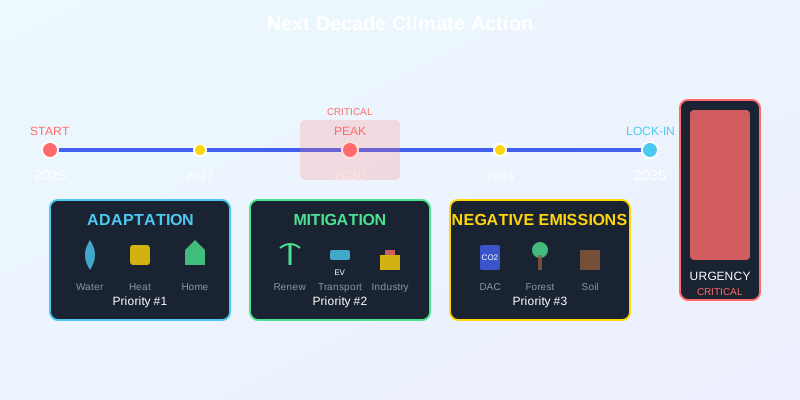
We use the 170 Gt figure because it comes from the same report as our emissions data, but the lower 130 Gt estimate is just as credible. All of these figures will be revised when the Global Carbon Budget 2026 is published, expected in November 2026. For what the next ten years need to look like, read our guide to climate change from 2025 to 2035.
Questions and answers
How much carbon budget is left for 1.5 °C?
About 170 billion tonnes of CO₂ from 1 January 2026 for a 50% chance of keeping warming to 1.5 °C, according to the Global Carbon Budget 2025, or 130 billion tonnes according to the Indicators of Global Climate Change 2025. At 2025 emission rates of about 42 billion tonnes a year, that is three to four years. Budgets with a higher chance of success are smaller still.
How many years until the world reaches 1.5 °C?
Human-caused warming was about 1.37 °C in 2025 and rising by about 0.27 °C per decade, so at that pace it would reach 1.5 °C around 2030. The 1.5 °C carbon budget runs out on a similar timeline, around 2029–2030 at current emissions.
What happens when the carbon budget runs out?
Nothing sudden happens on the day. It means the world has emitted enough CO₂ that 1.5 °C is more likely than not to be exceeded. Every further tonne adds a little more warming, so cutting emissions still matters; bringing temperatures back down after an overshoot would require removing more CO₂ than is emitted.
What is the carbon budget for 2 °C?
About 1,055 billion tonnes of CO₂ from the start of 2026 for a 50% chance of staying below 2 °C (Global Carbon Budget 2025), roughly 25 years at current emissions. For 1.7 °C it is about 525 billion tonnes, or 12 years.
Why does the carbon budget keep getting smaller?
Partly because the world keeps emitting around 42 billion tonnes of CO₂ a year, and every tonne comes straight off the budget. Estimates also change as scientists update how much warming has already happened and how much extra warming methane and other non-CO₂ factors will add.
Sources
- Friedlingstein et al., Global Carbon Budget 2025, Earth System Science Data, 2026
- Fossil fuel CO₂ emissions hit record high in 2025 (press release), Global Carbon Project, 2025
- The Global Carbon Budget FAQs 2025, Global Carbon Project, 2025
- Global Carbon Budget 2024 FAQs, Global Carbon Project, 2024
- Forster et al., Indicators of Global Climate Change 2025, Earth System Science Data, 2026
- Indicators of Global Climate Change: IGCC 2025 dashboard, Copernicus Climate Change Service
- Global warming reached 1.37 °C in 2025, Priestley Centre for Climate Futures, University of Leeds, 2026
- Climate Change 2021: The Physical Science Basis, Summary for Policymakers (TCRE, Table SPM.2), IPCC, 2021
- Climate Change 2022: Mitigation of Climate Change, Summary for Policymakers, IPCC, 2022
- Analysis: What the new IPCC report says about how to limit warming to 1.5C or 2C, Carbon Brief, 2022
- Analysis: Fossil-fuel CO₂ emissions to set new record in 2025, as land sink ‘recovers’, Carbon Brief, 2025
- Nine key takeaways about the ‘state of CO₂ removal’ in 2024, Carbon Brief, 2024
- The State of Carbon Dioxide Removal, 2nd edition, Smith et al., 2024